
- Buy DVD Online!
- Batto-Do Championships Registration
- Black Belt Rank
- Katana Video Trailers
- Martial Arts Instructor
- Samurai Sword History
- Batto-Do/Kendo/Iaido History
- Katana & Japanese Swords
- Tatami/Goza Mats Target
- Japanese Sword Cleaning
- Sword Safety Lesson
- Free Guided Meditation
- Join Facebook Martial Arts


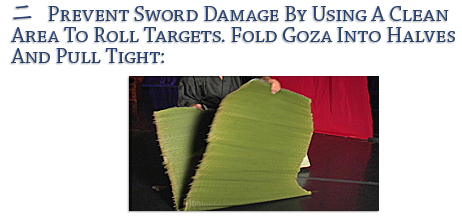
Tatami Omote and Goza Mats as Cutting Targets
For all the mystique surrounding tameshigiri, the target itself is a remarkably ordinary object. Tatami omote is the woven rush face of a tatami mat — the part you see on the floor of a Japanese room. When a mat is retired, the omote is stripped, rolled tightly into a cylinder and soaked in water. The result is a target soft enough to accept a well-aligned cut and dense enough to expose a bad one. A roll of goza teaches the same lesson a partner teaches in paired practice: the blade either travels straight through the line of the cut, or the roll folds, bends and hangs off the blade to announce the mistake. Nothing else available to a civilian practitioner gives such clear feedback, and nothing else is as inexpensive or as easy to replace.
Goza sold for cutting is usually the same rush weave, cut to shorter lengths and bundled. It is not the stiff, plastic-bound floor mat sold in a hardware shop, and it is not the dense straw bale used for archery. What you want is a rush or igusa weave with a little flexibility. Dry, it should bend without cracking. If it snaps when you fold a corner, it has dried out too far and will behave like a bundle of brittle sticks rather than a target.
Where to Find Cutting Mats
Martial arts suppliers, the larger dojo equipment dealers and Japanese home-goods importers all carry omote for cutting, normally sold by the bundle or by length. A full tatami face is roughly one ken by half a ken; sellers usually cut these into half or third panels, which roll neatly into a single-target cylinder about 8 to 10 cm across. Buy more than you think you need — shipping costs more than the mats do, and a bundle stores for years if kept dry, rolled loosely, off a concrete floor and out of direct sun. If you cannot find omote, a cheap woven beach mat will serve as a practice substitute, but it is softer and cuts more easily, so treat it as a beginner target rather than a test of skill.
Rolling the Target
A rolled target should be tight and even. Lay the panel flat, brush off sand and grit, then roll from one narrow end with steady pressure from both hands, working along the length as you go. The far end must stay square. A roll that tapers at the tip cuts differently at the top and bottom of the same stroke, and students then spend weeks correcting a fault that comes from their preparation rather than from their hands.
Hold the roll closed with two or three loops of string or a rubber band, just enough to keep its shape while it soaks and while it is carried to the stand. Remove them before cutting. Anything hard in the cutting line — string, wire, band, staple — will nick a sharp edge and can turn a clean cut into a chip. Some practitioners slip a bamboo or plastic dowel through the middle to hold the roll straight, which is fine so long as the dowel stops well short of the cut and you can see that it does.
Soaking the Roll
Soak the rolls fully submerged in fresh water, weighted so they cannot float. Twelve to twenty-four hours is usual; thin rolls need less, thick bundles need more. In warm weather, change the water every twelve hours — standing water develops a smell quickly and the mat will carry it into the dojo. What you are looking for is a roll that is heavy and pliable all the way through the middle, not just at the surface. A roll that is wet outside and dry in the core cuts deceptively easily at first and then stops the blade dead, which is one of the classic causes of a bent sword.
Modern practice often adds a draining step: after soaking, stand the rolls upright for a few hours so excess water runs out. This gives a target that is firm rather than soggy, and it feels to the blade closer to the resistance of a real body. For a harder test, use an older, coarser roll, soak it thoroughly and drain it only briefly. For a demonstration cut, freshly soaked thin rolls are the friendlier choice.
Stands and Mounting
The traditional stand is a weighted base with a pair of uprights holding a dowel; the roll slips over the dowel and rests between the uprights. The blade must pass only through the rush. Before you cut, check that the roll sits clear of the wood, the metal pins and the top of the base, and above all that the dowel does not reach the point where you intend to cut.
Whatever stand you use, it must be stable enough to take a firm stroke without walking across the floor, and heavy enough that the impact of a miscut does not tip it toward the person cutting. Sandbags or a broad timber foot do this work. Many practitioners use a hanging target instead, suspended from a frame or a sturdy beam, since a hanging roll swings rather than resists and is more forgiving of an imperfect line of cut. Neither style should ever be set up so that the follow-through carries the blade toward a person, a wall or a window.
Safety, Every Single Time
Check the roll for hidden hazards — staples, gravel, plastic ties — then check the blade itself: a loose fitting, a cracked tsuka, movement in the mekugi, a nick left by the previous session. Cutting a tatami roll with a chipped edge turns a small nick into a fracture, and a fracture means a sword in pieces and a very expensive lesson.
Then check the space. Everyone except the person cutting should stand outside the arc the blade can reach, which means further back and further to the sides than most beginners estimate. No spectators behind the stand, no camera operator leaning in for a close-up, and no one retrieving a severed top piece until the sword is sheathed and the practitioner has stopped. Footing matters too: soaked mats mean water on the floor, so a dry, grit-free surface is part of the setup. A small tarp or mat under the stand catches the water and the pieces of rush, and cushions the sword if something goes wrong.
What Makes a Cut Work
Because a soaked roll is heavy, the target rewards hasuji above all else — the edge travelling exactly in the plane of the swing. If the edge arrives at an angle to its direction of travel, the blade bites, twists and stops, and the roll hangs from the sword instead of falling. Let the cut be an extension of the draw or the raise; the hands do not stop at the target. Meet the roll with accelerating speed rather than a hammer blow, and cut through, not to, the target: the blade should leave the far side at speed.
Start with the angle you know best, usually the diagonal from the shoulder, and repeat it until the roll falls the same way every time. Then change the height of the target and cut the same stroke; then change the angle. Only when a single roll falls cleanly most of the time is it worth adding a second and third target to the stand.
A Workable Practice Progression
Begin with a soft, freshly soaked single roll, then a tighter roll, then an older, coarser mat. Move the standing target to a different height, then set two targets of different heights, then a sequence — cut, step, cut — in which the feet must do work between strokes. Keep a note of what you cut, over how many sessions, and what the rolls did. The mats do not lie, and a written record shows you progress you would otherwise not notice.
After the Cut
Wipe the blade immediately. Soaked rush leaves water and plant residue on the steel, and even a modern alloy will begin to mark if the sword is put away damp. Dry the blade, oil it lightly, inspect the edge along its whole length, and only then take your equipment apart. A cut mat is finished: do not try to dry, re-roll and reuse it, because the weave will have opened and the roll will no longer hold its shape.