
- Buy DVD Online!
- Batto-Do Championships Registration
- Black Belt Rank
- Katana Video Trailers
- Martial Arts Instructor
- Samurai Sword History
- Batto-Do/Kendo/Iaido History
- Katana & Japanese Swords
- Tatami/Goza Mats Target
- Japanese Sword Cleaning
- Sword Safety Lesson
- Free Guided Meditation
- Join Facebook Martial Arts


Why a Katana Must Be Cleaned Every Time It Is Touched
A Japanese sword is made of polished steel and, in most cases, of steel that has been folded, hardened and left with a very thin, very active surface. That surface begins to react the moment it meets moisture, salt or the acids in human skin. A fingerprint left on a blade and ignored for a week can etch a permanent mark into the polish. This is not an exaggeration used to frighten new students — it is the single most common cause of damage to otherwise fine swords, and it is entirely preventable. Cleaning a katana is therefore not a chore that follows training; it is part of training, and it is performed the same way in a beginner's first week as it is by a teacher with forty years behind him.
The routine described below is the traditional one used in Japanese dojo and collections. It takes about ten minutes for a single sword and requires no special skill, only attention. Practise it on an unsharpened iaito or a bokken first if you are not yet confident handling a live blade, and never rush the final steps.
The Cleaning Kit: What Each Item Does
Uchiko powder. A fine white abrasive powder made from burnt rice hulls or from polished grinding stone, sold inside a small ball or bulb. It is tapped lightly along the blade and spread with a soft paper, never rubbed hard. Its job is to lift old oil, dust and hardened residue without altering the geometry of the blade. Used gently it is harmless; used like sandpaper it will dull a polish. On a newly polished sword or a blade in very good condition, many collectors skip the uchiko altogether and simply wipe and re-oil.
Choji oil. Clove oil, traditionally a blend of light mineral oil and a small proportion of clove essence. The clove is not there for the smell alone — it helps the oil spread thinly and discourages corrosion. Only a few drops are needed for a whole blade. Any cloth or paper that touches the oil should be kept clean, because grit carried on an oily rag is grit that will be dragged along the steel.
Nuguigami and other papers. Nuguigami is soft, unsized rice paper used for wiping the blade clean before oiling. It is used in fresh sheets, folded, and discarded after a session so that nothing abrasive is ever reused. Some practitioners keep separate paper for removing old oil and for the final wipe, which is a good habit. Never use tissue paper, kitchen roll or a rag that has been near metal or dust.
Mekugi-nuki. A small brass or bone hammer used to push out the mekugi, the bamboo peg that locks the tang into the handle. Brass is used because it is softer than the sword's fittings and will not peen over the peg or scar the handle. The mekugi-nuki is only needed when the sword is to be taken apart for inspection, which should be done sparingly.
An oiling cloth. A clean, soft cloth kept exclusively for this purpose. Some sword owners use a folded piece of the same rice paper; either is acceptable provided it stays clean and is stored away from dust.
The Step-by-Step Routine
Seat yourself at a table with the sword laid in front of you, edge facing away, handle to the left if you are right-handed. Sit so that you are not leaning over the blade, and keep children, pets and loose clothing out of the room. Announce your intention to draw the sword if anyone else is present, exactly as you would in a dojo.
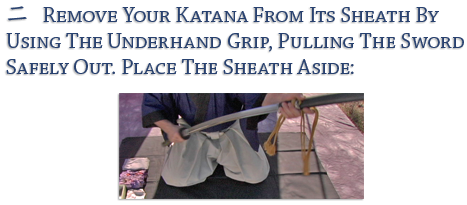
Remove the sword from the saya slowly, holding the saya with the left hand and the handle with the right. Keep the cutting edge upward and draw in one smooth motion, letting the blade's spine travel along the mouth of the sheath so that it never scrapes the edge. Lay the saya to one side, mouth upward, and never lean a naked blade against a wall or the edge of a table.
Wipe the blade first. Take a fresh sheet of nuguigami and pass it from the base of the blade toward the tip, in one direction only, lifting the paper away before it returns. Turn the paper and repeat along the spine and along the back of the blade. Do not scrub back and forth, and do not run the paper over the edge itself; the paper should ride the flat of the blade. New paper for each pass, and a fresh sheet when the old one is dark with oil.
Apply uchiko if you intend to use it. Tap the ball lightly two or three times along the length of the blade so that a faint dusting falls on the steel, then spread it with another fresh sheet of paper in the same base-to-tip direction. The powder lifts residue out of the surface. Wipe it off completely with a clean sheet. If the blade is newly polished or in excellent condition, this step can be omitted.
Oil the blade. Put two or three drops of choji oil onto a clean cloth or paper, let the drops spread, and then draw the cloth along the blade from base to tip. The goal is a barely visible film — a sheen, not a coating. Excess oil collects dust, runs into the habaki and the mouth of the saya, and eventually turns gummy. One pass is enough; a second pass along the spine is optional.
Return the sword to the saya carefully, spine first, edge up, guiding the blade rather than dropping it in. Then wipe the outside of the saya, check that the kurikata and the sageo are sound, and store the sword horizontally in a dry place, out of direct sunlight and away from heating vents.
Inspecting the Blade and the Fittings
Once or twice a year a sword should be taken apart for inspection. Push out the mekugi with the mekugi-nuki, remove the handle from the tang with a gentle tap of the palm, and look at the tang, the habaki and the inside of the handle. Check that the mekugi is not cracked or split, that the habaki still fits snugly, and that the tang shows no active red rust — a dark, stable patina is normal and should never be cleaned off, as it protects the metal and carries the smith's signature.
When reassembling, insert the mekugi from the same side it was removed, with a soft mallet and light taps, and confirm the blade sits firmly without rattle. Replace a split peg with new bamboo of the correct diameter. Never force a handle onto a tang, and never use a metal pin as a substitute — a wooden peg is designed to fail before the blade or the fittings do.
Caring for the Saya and the Handling of the Blade
The saya is the sword's house and deserves the same attention as the steel. Never store a blade in a wet or oil-soaked saya. If the inside of the sheath becomes clogged with old oil and dust, a wooden saya can be cleaned by wrapping fine paper around a thin wooden strip and drawing it through, and a lacquered saya should be wiped only with a dry, soft cloth. Do not use water, alcohol or household cleaners on lacquer, and do not leave the saya in a hot car — heat warps the wood and cracks the lacquer.
Handle the sword by the tsuka, never by the blade. Pass a sword to another person only after the two of you have agreed on the exchange, handle toward the receiver, edge toward the giver. Keep the sword out of the path of anyone walking behind you. In a dry climate such as Arizona, rust is less of a threat than in coastal regions, but dust and dryness bring their own problems: dust settles into oil film, and very dry air can shrink wooden fittings until they loosen. A monthly check is enough to catch both.
Common Mistakes to Avoid
Touching the blade with bare fingers, even briefly, undoes the work of an entire cleaning session. Breathing on the steel leaves moisture. Leaving a sword in its saya for months without inspection allows rust to begin where you cannot see it. Using too much oil, using the wrong oil, or using the same dirty rag for years will all eventually show in the polish. And cleaning in a hurry — with the sword laid across a kitchen table, with people moving around you, with the phone in your other hand — is how accidents happen and how edges are chipped.
Finally, remember that a DVD or a written guide can show you the sequence but cannot watch your hands. If you train with a group or a teacher, ask them to watch your cleaning routine once and correct it. It is a short lesson that will protect your sword for the next fifty years.