
- Buy DVD Online!
- Batto-Do Championships Registration
- Black Belt Rank
- Katana Video Trailers
- Martial Arts Instructor
- Samurai Sword History
- Batto-Do/Kendo/Iaido History
- Katana & Japanese Swords
- Tatami/Goza Mats Target
- Japanese Sword Cleaning
- Sword Safety Lesson
- Free Guided Meditation
- Join Facebook Martial Arts

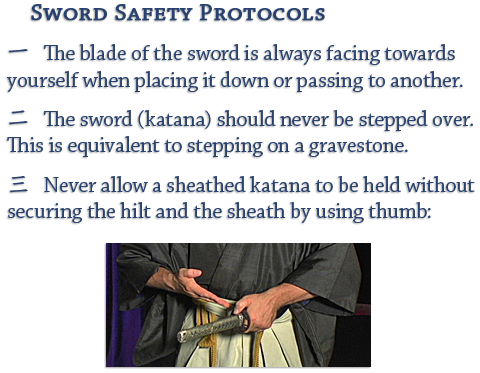
The Sword Safety Lesson Comes First
Every student who has ever picked up a katana in our dojo hears the same thing before they learn a single cut: the first lesson of the sword is not how to draw it, it is how to live with it. A live blade does not care how long you have trained, how expensive your sword is or how good your intentions are. It only cares whether the edge is pointed somewhere safe and whether your hands are where they are supposed to be. This page collects the rules we repeat constantly, the ones that keep people training into their sixties with all their fingers intact.
Before You Touch the Blade: Inspect the Sword
Pick up any sword and the first thing to check is the mekugi — the small peg that holds the tang inside the handle. A loose or missing mekugi is the single most common cause of a blade leaving its handle in mid-swing, and it is entirely preventable. Push the peg with your thumb; it should be firm and fully seated. On a shinken the mekugi should be made of bamboo or horn, never a metal nail. If you can slide the tsuka even slightly forward or back, stop and have it repaired before the sword is used again. Check the habaki for tightness, run a dry cloth along the blade to look for bends, chips or rust, and confirm the blade is properly seated in the saya with no wobble at the mouth (koiguchi).
Never inspect an edge with your fingers, and never test sharpness on paper held in your hand. If you must look closely at the blade, hold the sword vertically or pointing away from your body, blade edge turned outward, with the tsuka in your left hand at chest height. Pass a sword to another person only after announcing it, offering the tsuka first with the edge facing the receiver, and waiting for them to take it with both hands.
Drawing and Sheathing: Nukitsuke and Noto
Nukitsuke is the draw-and-cut, and it is where most self-inflicted injuries happen. The rule is simple: the saya moves back as the right hand comes forward, in one coordinated motion. The left hand holds the saya close to the body, thumb on the tsuba, and pulls rearward with sayabiki. A slow, deliberate draw from a well-seated saya is safer and faster than a violent snatch from a loose one. Never draw toward another person, never draw with the tip angled at your own thigh or armpit, and never let the blade leave the koiguchi until your body has already begun to turn.
Noto, the return to the saya, is where beginners cut their hands. The blade must be wiped of moisture and loose debris before it goes back — never sheath a dirty blade. Bring the tip to the koiguchi with the edge facing up, feel the mouth of the saya with the back of the blade, and slide in with a light, continuous motion, letting the left hand guide rather than the right hand push. If the sword does not enter smoothly, stop, look at the angle and start again. Forcing a katana into its saya is how people crack the saya, fold the edge and slice their palm in the same second. Practise noto hundreds of times slowly before you ever try it at speed, and use a bokken or an iaito until the motion is automatic.
Sageo Knot and Securing the Saya
The sageo is the cord on the saya, and it exists for control, not decoration. A properly tied sageo keeps the scabbard from swinging, from sliding out of your obi or belt, and from turning in your hand during a draw. Tie it so the knot sits on the outer face of the saya, leaving roughly a hand-span of cord for adjustment, and loop it through the obi or training belt so the saya stays where you put it. Check the knot before every session and retie it if the cord has frayed, glazed or stiffened — a sageo that snaps mid-draw leaves you holding a loose scabbard and a live edge with nothing to control it.
When you step away from practice, the saya goes with the sword. Never leave a katana lying bare on the floor, never lean a sheathed sword against a wall where it can slide, and never rest a blade in the koiguchi with the tip balanced in the mouth of the scabbard. Keep the sword on a stand (katana-kake), on a rack, or in a case, and keep it out of reach of children and pets.
The Training Space
Before class, walk the area. There must be enough clear floor for a full draw and a full noto without the tip approaching a wall, a table or a training partner. Roughly two metres of open space on each side is a sensible minimum. Check the ceiling height, because a raised kensen in close-quarter kata can reach it, and check for loose mats, splinters and water on the floor. Mark or remove anything a bare or socked foot could catch on.
Practise one person per lane, facing the same direction as the group, so a slip sends a blade into open air rather than into the next student. Anyone not practising stays behind the line and out of the lane. When working with a partner, agree the distance, agree the form and stop immediately on the first loss of control rather than trying to recover mid-technique. Sparring with live blades is not practised in respectable schools, and no amount of confidence justifies it.
Etiquette and Habits That Keep You Safe
Bowing (rei) on entering and leaving the training floor is not merely tradition. It creates a pause, and that pause is where you check the mekugi, check the sageo, look at your lane and decide whether you are calm enough to handle steel today. Never walk in the dojo with a bare blade, never step over a sword lying on the floor, never point a blade at anyone even in jest, and never touch someone else's sword without asking the owner first. Announce the technique with a clear kiai; that force is directed outward, not held inward, and a held breath is a distracted mind.
Stop at once if your hands are tired, if you are angry, or if you are thinking about anything other than the blade in front of you. Fatigue and temper cause more cuts than technique does. Set the sword down, sheathe it properly, and take a break. The greatest swordsmen in these traditions were not the fastest men in the room; they were the ones who never had a serious accident, because they treated every single draw as if it were the first.
Contact Us